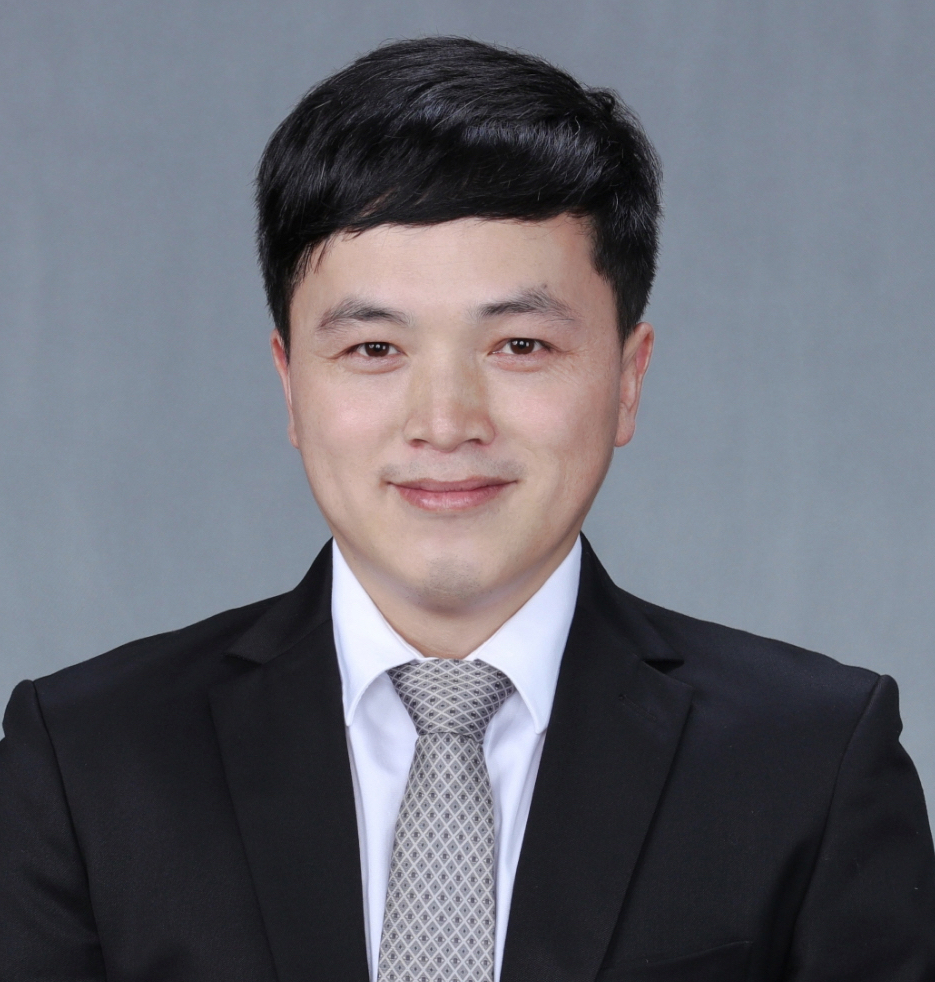
Yixiang Fang
Associate Professor
School of Data Science and School of Artificial Intelligence
The Chinese University of Hong Kong, Shenzhen
2001 Longxiang Boulevard, Longgang District, Shenzhen City, Guangdong Province, China
Director of M.Sc. in Computer Science Programme
Director of MPhil-PhD in Artificial Intelligence Programme
Coach of CUHK-Shenzhen Programming Contest Team
[Google Scholar], [DBLP]
Recent News
- [2026-5] Yixiang is recruiting PhD students to work on the topics of LLM and Agent. Please see the details of PhD Recruitment.
- [2026-5] We have released a comprehensive survey on Agent Skills (see arXiv paper).
- [2026-4] Yixiang was awarded the 2026 Tencent Rhino-bird Focused Research Fund.
- [2026-2] We have published several papers on Retrieval-Augmented Generation (RAG), including an RAG tuning system (SIGMOD'2026), graph-based RAG algorithms (ICDE'2026 and AAAI'2026), and an in-depth study of graph-based RAG methods (VLDB'2025) which compares 10+ methods extensively under a unified framework (https://github.com/JayLZhou/GraphRAG).
- [2026-1] Yixiang will co-organize the Agents+Graph@VLDB2026 workshop: 3rd International Workshop on Data Management Opportunities in Bringing Agents with Graph Data.
- [2025-11] Yixiang has held a Joint Appointment with School of Artificial Intelligence, CUHK-Shenzhen since Nov 2025.
- [2025-9] Yixiang was awarded the 2025 CCF-Huawei Populus Grove Fund (see more details).
- [2025-7] Yixiang received the 2025 CUHK-Shenzhen Teaching Achievement Award (Excellent Prize).
- [2025-6] Yixiang was awarded the 2025 CCF-Ant Research Fund (see more details).
Biography
Yixiang Fang is an Associate Professor at the Chinese University of Hong Kong, Shenzhen. Previously, he was a Research Associate at the School of Computer Science and Engineering, the University of New South Wales (UNSW), Australia, during 2018 - 2020. He received the PhD from Department of Computer Science at the University of Hong Kong (HKU), Hong Kong, in 2017. He was a visiting scholar at Nanyang Technological University in 2016.
Yixiang Fang's general research interests mainly focus on the data-centric AI and big graph analytics. He has published extensively in the areas of database, data mining, and artificial intelligence, including One of the Best Papers in SIGMOD 2020 (a world flagship conference in database areas), and most of them are published in top-tier conferences (e.g., VLDB, SIGMOD, ICDE, KDD, NeurIPS, WWW, and AAAI) and journals (e.g., TODS, VLDBJ, and TKDE). He was awarded the 2021 ACM SIGMOD Research Highlight Award and the 2025 CUHK-Shenzhen Teaching Achievement Award (Excellent Prize). Currently, he is an Editorial Board Member of the journal Information Processing & Management (IPM, IF: 6.9). He was a PC co-chair of LLM+Graph@VLDB2025 workshop and Agents+Graph@VLDB2026 workshop. He has also served on the program committees of several top conferences (e.g., VLDB, ICDE, KDD, WWW, and AAAI) and as an invited reviewer for top journals (e.g., TKDE and VLDBJ) in the areas of database, data mining, and artificial intelligence. He is a member of ACM, IEEE, and CCF.
Recent Research Interests
Yixiang Fang's general research interests mainly focus on the data-centric AI and big graph analytics. Currently, he is mainly working on the research topics of graph-based retrieval-augmented generation, agent memory management, community search, densest subgraph discovery, and so on.
Contact
Room 521a, Dao Yuan Building, CUHK-Shenzhen
2001 Longxiang Boulevard, Longgang District, Shenzhen, China
fangyixiang at cuhk.edu.cn (preferred)
fangyixianghku at gmail.com
Research Interests: Overview
Yixiang Fang's general research interests mainly focus on the data-centric AI and big graph analytics. The specific research topics are listed as follows:
- Data-centric AI: retrieval-augmented generation, agent memory management, intelligent agents, agent skill management, and LLM-assisted pattern mining.
- Big graph analytics: community search, densest subgraph discovery, cohesive subgraph search, connectivity/path query, motif counting, node importance estimation, similarity/relevance computation, and graph neural network.
The three most representative topics that Yixiang has studied are Retrieval-Augmented Generation (RAG), Community Search (CS) and Densest Subgraph Discovery (DSD), which are introduced as follows.
Representative Research Topics
Topic 1: Retrieval-Augmented Generation (RAG)
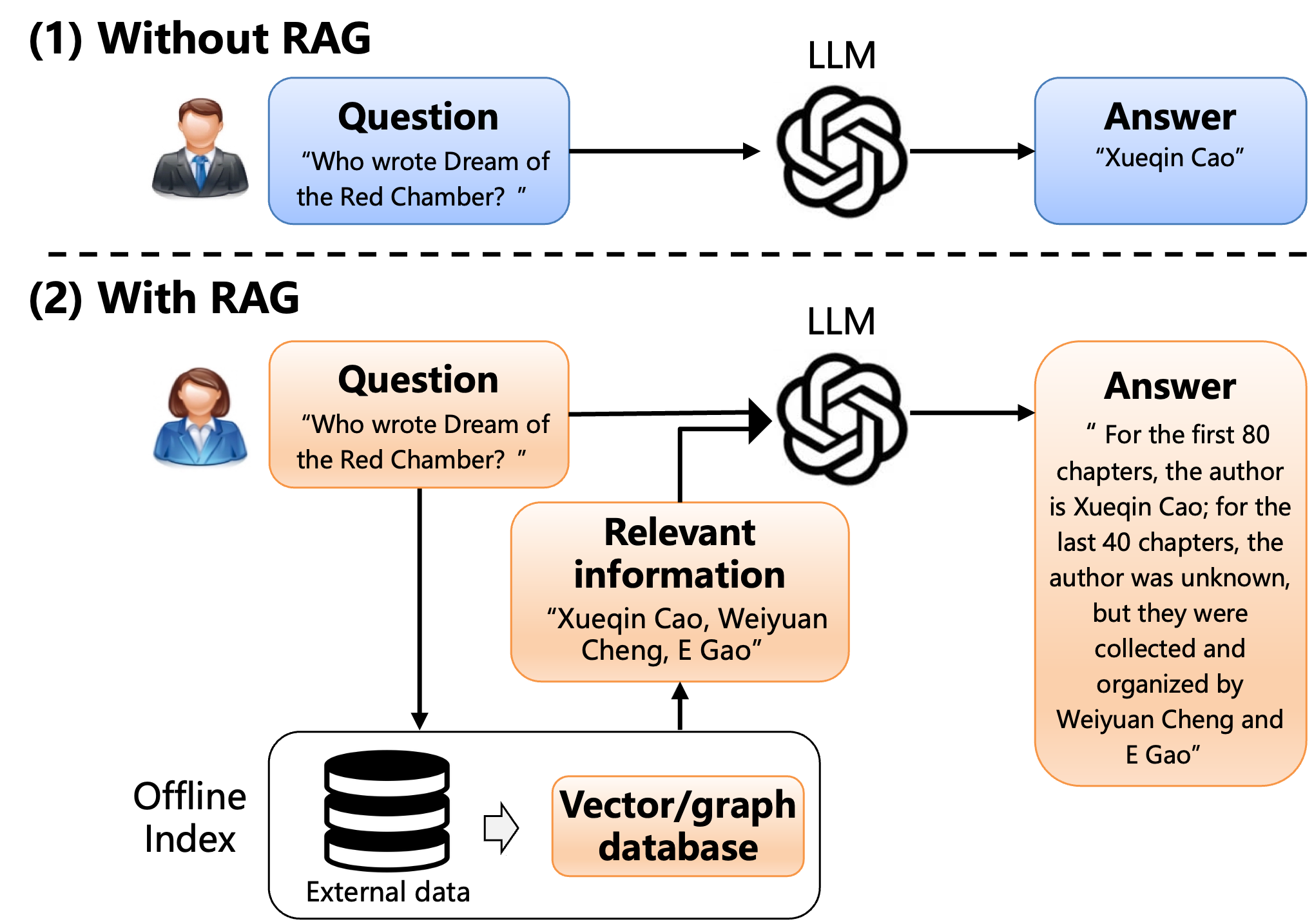
Retrieval-Augmented Generation (RAG) has emerged as a core approach for enhancing large language models (LLMs) by enabling access to domain-specific and real-time updated knowledge beyond their pre-training corpus. By improving the trustworthiness and interpretability of LLMs, RAG has been widely adopted across a broad range of applications such as question-answering. Recently, it has received tremendous attention from the researchers in the database, data mining, machine learning, and natural language processing communities. Yixiang has worked extensively on this topic and delivered a number of highly promising research outcomes, including graph-based RAG algorithms, RAG systems, and agent memory mechanisms.
In particular, Yixiang's works on RAG have been well recognized by leading IT companies, and his research was funded by CCF-Ant Research Fund, CCF-Huawei Populus Grove Fund, Tencent Rhino-bird Focused Research Fund, and Lalamove University-Enterprise Cooperation Fund.
Topic 2: Community Search (CS)
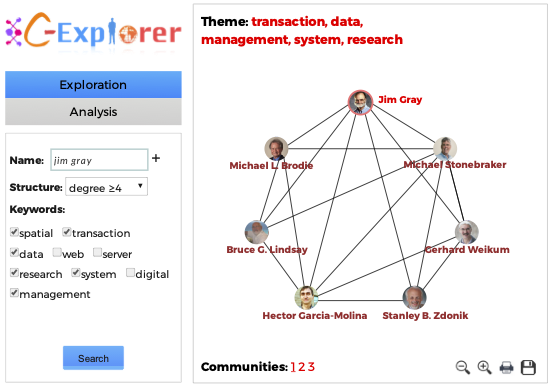
As a hot topic of subgraph query in the network science, CS aims to efficiently query the most likely community that contains the query vertex. It has attracted great attention from both academic and industry areas, and found various real-world applications, such as friend recommendation, event organization, fraud detection, network analysis, and retrieval augmented generation (RAG) for LLMs. Yixiang has systematically studied this topic on attributed graphs, directed graphs, and heterogeneous graphs, and achieved significant contributions by developing new models, efficient algorithms, and innovative theories. Additionally, he has published a book about cohesive subgraph search over heterogeneous graphs.
In particular, Yixiang's works on cohesive subgraphs have been well recognized by leading IT companies. His works on community search on knowledge
graphs and temporal graphs have been funded by CCF-Huawei Populus Grove Fund and ByteDance, respectively.
Topic 3: Densest Subgraph Discovery (DSD)
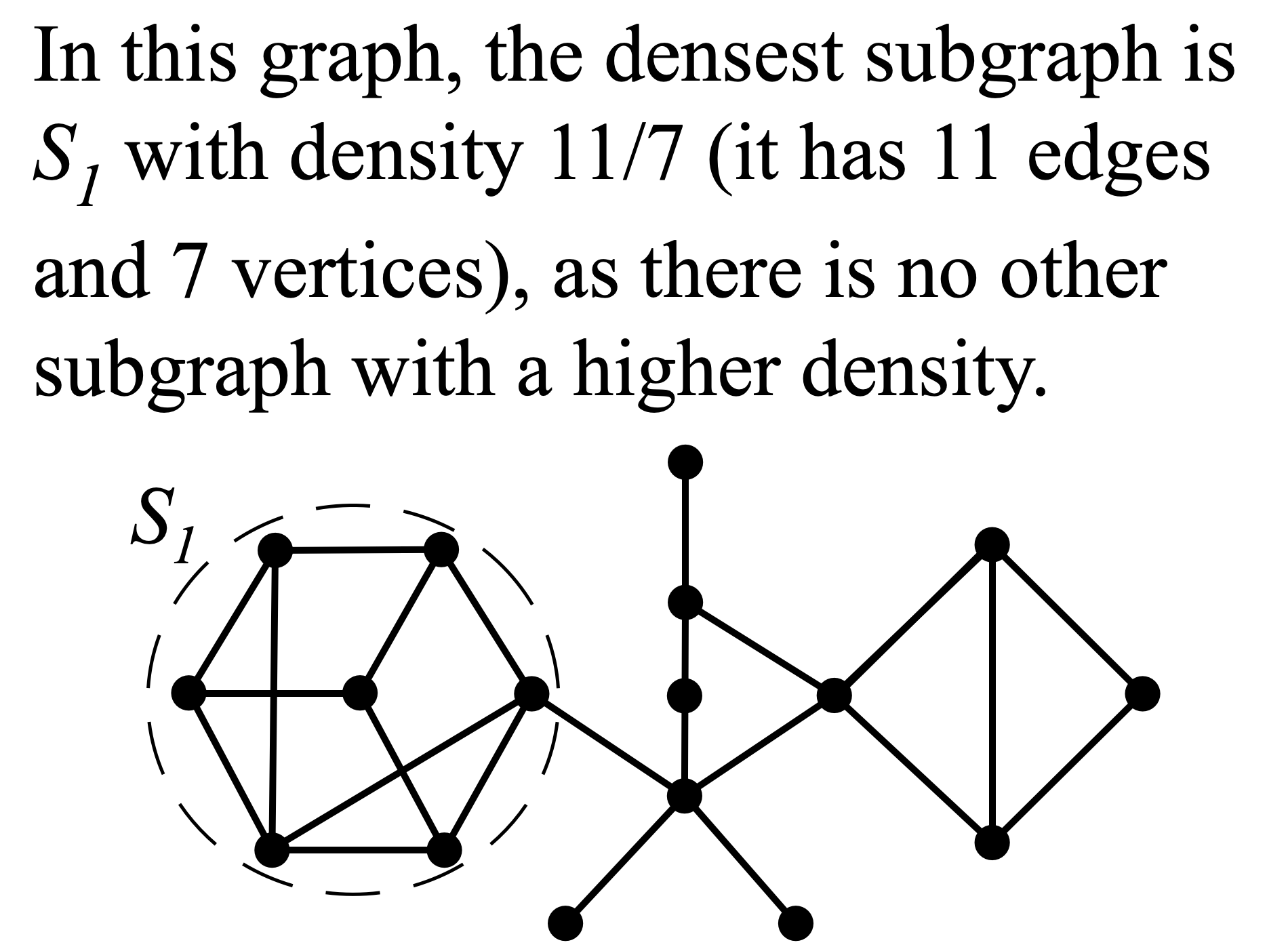
As one of the most fundamental graph mining problems, DSD aims to discover the subgraph with the highest density from a given graph. More precisely, given an undirected graph, the DSD problem asks for a subgraph with the highest density, defined as the number of edges over the number of vertices in the subgraph, and it is often termed the densest subgraph. This topic has garnered tremendous attention from both database and theory areas in recent years. It has found a broad spectrum of real applications, such as network community detection, graph index construction, regulatory motif discovery in DNA, fake follower detection, etc. Yixiang has continuously worked on this topic, and achieved a series of breakthroughs, including novel DSD algorithms, in-depth experimental study, tutorial, and survey.
In particular, Yixiang's SIGMOD'2020 paper about DSD on directed graphs was selected as One of the Best Papers in SIGMOD'2020 conference, and he was awarded The 2021 SIGMOD Research Highlight Award.
Research Honors
- Innovation Award for Outstanding Research Achievement, The 27th China Hi-tech Fair, 2025
- ICDE Best Program Committee Member Award, 2025
- Excellent Reviewer, KDD, 2025
- Excellent Reviewer, Applied Data Science (ADS) Track of KDD, 2024
- ACM SIGMOD Research Highlight Award, 2021
- VLDB Endowment Grants @ VLDB 2021
- Best Paper Award, International Conference on Spatial Data and Intelligence (SpatialDI) 2021
- Presidential Young Fellow at CUHK-Shenzhen, 2021
- One of the Best Papers, SIGMOD 2020
Selected Publications
[ Full List, Google Scholar, DBLP, the star (*) indicates that Yixiang is a corresponding author ]- Guanghao Liang, Yixiang Fang*. Structure Sparsification and Sparsity Estimation for Efficient Sparse Matrix Multiplication. Proceedings of the VLDB Endowment (PVLDB), 2027.
- Chunxu Lin, Yumao Xie, Yixiang Fang*, Yongmin Hu, Yingqian Hu, Cheng Chen. Maintaining Leiden Communities in Large Dynamic Graphs. IEEE International Conference on Data Engineering (ICDE), 2027.
- Jingbang Chen, Weinuo Li, Yingli Zhou, Hangrui Zhou, Qiuyang Mang, Can Wang, Yixiang Fang, Chenhao Ma. Scalable Approximate Biclique Counting over Large Bipartite Graphs. IEEE International Conference on Data Engineering (ICDE), 2027.
- Zhuo Ma, Kaiyu Chen, Dong Wen, Yixiang Fang, Wenjie Zhang. Accelerating Historical K-Core Search in Temporal Graphs. IEEE Transactions on Knowledge and Data Engineering (TKDE), 2027.
- Yingli Zhou, Zixuan Wang, Yixiang Fang*. HAMMER: An Automatic RAG Tuning System via Hierarchical Memory-Guided Monte Carlo Tree Search. ACM International Conference on Management of Data (SIGMOD), 4(3):194:1-194:29, 2026.
- Yingli Zhou, Youran Sun, Yixiang Fang*. Efficient Anchored Densest Subgraph Discovery: Improved Time Complexity and Practical Performance. ACM International Conference on Management of Data (SIGMOD), 4(3):167:1-167:27, 2026.
- Qiaoyuan Yang, Wensheng Luo, Yixiang Fang*, Yuanyuan Zeng. Order-based Algorithms for Efficient Core Maintenance in Large Bipartite Graphs. ACM International Conference on Management of Data (SIGMOD), 4(1):60:1-60:26, 2026.
- Youran Sun, Yingli Zhou, Yixiang Fang*, Cheng Chen, Yongmin Hu, Yingqian Hu. Efficient Influential Community Search over Dynamic Graphs. ACM International Conference on Management of Data (SIGMOD), 4(6):30:1-30:28, 2026.
- Angela Bonifati, Yixiang Fang, Sibo Wang, Yingli Zhou. Graph-Based Retrieval-Augmented Generation: Applications, Challenges, Solutions, and Opportunities. Proceedings of the VLDB Endowment (PVLDB), 2026.
- Shu Wang, Yingli Zhou, Yixiang Fang*. BookRAG: A Hierarchical Structure-aware Index-based Approach for Retrieval-Augmented Generation on Complex Documents. Proceedings of the VLDB Endowment (PVLDB), 2026.
- Yingli Zhou, Huizhong Wang, Chenhao Ma, Yixiang Fang*. A Semantics-aware Approach for Graph Edit Distance Estimation over Knowledge Graphs. Proceedings of the VLDB Endowment (PVLDB), 19(6): 1226-1239, 2026.
- Yingli Zhou, Taohua Huang, Yixiang Fang*. Efficient Locally h-Clique Densest Subgraph Discovery via Divide-and-Conquer. Proceedings of the VLDB Endowment (PVLDB), 2026.
- Jingbang Chen, Weinuo Li, Yingli Zhou, Hangrui Zhou, Qiuyang Mang, Can Wang, Yixiang Fang, Chenhao Ma. Scalable Approximate Biclique Counting over Large Bipartite Graphs. Proceedings of the VLDB Endowment (PVLDB), 19(4): 576-588, 2026.
- Yaodong Su, Yixiang Fang*, Yingli Zhou, Chuanhui Yang. Clue-RAG: Towards Accurate and Cost-Efficient Graph-based RAG via Multi-Partite Graph-based Index. IEEE International Conference on Data Engineering (ICDE), 2026.
- Luocheng Liang, Yingli Zhou, Yixiang Fang*. Accelerated Coordinate Descent for Directed Densest Subgraph Discovery. ACM SIGKDD Conference on Knowledge Discovery and Data Mining (KDD), pages 783-794, 2026.
- Shu Wang, Yixiang Fang*, Yingli Zhou, Xilin Liu, Yuchi Ma. ArchRAG: Attributed Community-based Hierarchical Retrieval-Augmented Generation. AAAI Conference on Artificial Intelligence (AAAI), pages 15868-15876, 2026.
- Yuyang Xia, Haoxuan Xie, Yixiang Fang*, Wensheng Luo, Chenhao Ma, Dong Wen. Efficiently Querying Connected Components in Large Temporal Graphs via Scalable and Maintainable Indices. The VLDB Journal (VLDBJ), 2026.
- Yingli Zhou, Tianjing Zeng, Rong Zhu, Yingze Li, Junwei Lan, Zhewei Wei, Yixiang Fang*, Bolin Ding, Jingren Zhou. Lamba: A Pretrained Model for Latency Prediction over Distributed Databases. The VLDB Journal (VLDBJ), 2026.
- Yingli Zhou, Luocheng Liang, Yixiang Fang*. Efficient and Scalable Directed Densest Subgraph Discovery. ACM International Conference on Management of Data (SIGMOD), 3(6):320:1-320:27, 2025.
- Yuyang Xia, Yixiang Fang*, Wensheng Luo. Efficiently Counting Triangles in Large Temporal Graphs. ACM International Conference on Management of Data (SIGMOD), 3(1):38:1-38:27, 2025.
- Yuanyuan Zeng, Yixiang Fang*, Wensheng Luo, Chenhao Ma. Accelerating Skyline Path Enumeration with a Core Attribute Index on Multi-attribute Graphs. ACM International Conference on Management of Data (SIGMOD), 3(3):124:1-124:1:26, 2025.
- Yingli Zhou, Yaodong Su, Youran Sun, Shu Wang, Taotao Wang, Runyuan He, Yongwei Zhang, Sicong Liang, Xilin Liu, Yuchi Ma, Yixiang Fang*. In-depth Analysis of Graph-based RAG in a Unified Framework. Proceedings of the VLDB Endowment (PVLDB), 18(13): 5623-5637, 2025.
- Yingli Zhou, Yige Jiang, Yixiang Fang*, Wensheng Luo, Yongmin Hu, Yingqian Hu, Cheng Chen. Effective Durable Community Search in Large Temporal Graph. Proceedings of the VLDB Endowment (PVLDB), 19(2): 127-140, 2025.
- Shu Wang, Yixiang Fang*, Wensheng Luo. Searching and Detecting Structurally Similar Communities in Large Heterogeneous Information Networks. Proceedings of the VLDB Endowment (PVLDB), 18(5): 1425-1438, 2025.
- Yingli Zhou, Qingshuo Guo, Yixiang Fang*. Efficient k-Clique Densest Subgraph Discovery: Towards Bridging Practice and Theory. Proceedings of the VLDB Endowment (PVLDB), 18(10): 3490-3503, 2025.
- Yufan Sheng, Xin Cao, Kaiqi Zhao, Yixiang Fang, Jianzhong Qi, Wenjie Zhang, Christian S. Jensen. ACE: A Cardinality Estimator for Set-Valued Queries. Proceedings of the VLDB Endowment (PVLDB), 18(7): 2112-2125, 2025.
- Yuanyuan Zeng, Yixiang Fang, Kun Chen, Yangfan Li, Chenhao Ma. Efficient Maintenance of 2-Hop Labeling Index on Dynamic Small-World Graphs. Proceedings of the VLDB Endowment (PVLDB), 18(7): 2005-2017, 2025.
- Qiuyang Mang, Jingbang Chen, Hangrui Zhou, Yu Gao, Yingli Zhou, Qingyu Shi, Richard Peng, Yixiang Fang, Chenhao Ma. Efficient Historical Butterfly Counting in Large Temporal Bipartite Networks via Graph Structure-aware Index. Proceedings of the VLDB Endowment (PVLDB), 18(6): 1607-1620, 2025.
- Yankai Chen, Taotao Wang, Yixiang Fang*, Yunyu Xiao. Semi-supervised Node Importance Estimation with Informative Distribution Modeling for Uncertainty Regularization. The ACM Web Conference (formerly known as International World Wide Web Conference (WWW)), pages 3108-3118, 2025.
- Yuyang Liang, Yankai Chen, Yixiang Fang, Laks V.S. Lakshmanan, Chenhao Ma. TRACE: Intra-visit Clinical Event Nowcasting via Effective Patient Trajectory Encoding. The ACM Web Conference (formerly known as International World Wide Web Conference (WWW)), pages 1118-1122, 2025.
- Yicheng Leng, Chaowei Fang, Junye Chen, Yixiang Fang, Sheng Li, Guanbin Li. Bridging Knowledge Gap between Image Inpainting and Large-Area Visible Watermark Removal. AAAI Conference on Artificial Intelligence (AAAI), 39(5): 4589-4597, 2025.
- Mengyao Li, Zhibang Yang, Xu Zhou, Yixiang Fang, Kenli Li, Keqin Li. Clustering on Attributed Graphs: From Single-view to Multi-view. ACM Computing Surveys, 57(7): 163:1-163:36, 2025.
- Yuanyuan Zeng, Yixiang Fang*, Chenhao Ma, Xu Zhou, Kenli Li. Efficient Distributed Hop-Constrained Path Enumeration on Large-Scale Graphs. ACM International Conference on Management of Data (SIGMOD), 2(1): 22:1-22:25, 2024.
- Chunxu Lin, Wensheng Luo, Yixiang Fang*, Chenhao Ma, Xilin Liu, Yuchi Ma. On Efficient Large Sparse Matrix Chain Multiplication. ACM International Conference on Management of Data (SIGMOD), 2(3): 119:2-119:27, 2024.
- Yingli Zhou, Qingshuo Guo, Yixiang Fang*, Chenhao Ma. A Counting-based Approach for Efficient k-Clique Densest Subgraph Discovery. ACM International Conference on Management of Data (SIGMOD), 2(3):156:2-156:27, 2024.
- Wensheng Luo, Qiaoyuan Yang, Yixiang Fang*, Xu Zhou. Efficient Core Maintenance in Large Bipartite Graphs. ACM International Conference on Management of Data (SIGMOD), 1(3): 208:1-208:26, 2024.
- Yingli Zhou, Qingshuo Guo, Yi Yang, Yixiang Fang*, Chenhao Ma, Laks V.S. Lakshmanan. In-depth Analysis of Densest Subgraph Discovery in a Unified Framework. Proceedings of the VLDB Endowment (PVLDB), 18(4): 1131-1144, 2024.
- Zheng Wu, Xuliang Zhu, Yixiang Fang, Jianliang Xu, Xin Huang. Interactive Graph Search for Multiple Targets on DAGs. Proceedings of the VLDB Endowment (PVLDB), 18(4): 1091-1103, 2024.
- Yingli Zhou, Yixiang Fang*, Chenhao Ma, Tianci Hou, Xin Huang. Efficient Maximal Motif-Clique Enumeration over Large Heterogeneous Information Networks. Proceedings of the VLDB Endowment (PVLDB), 17(11): 2946-2959, 2024.
- Wensheng Luo, Yixiang Fang*, Chunxu Lin, Yingli Zhou. Efficient Parallel D-core Decomposition at Scale. Proceedings of the VLDB Endowment (PVLDB), 17(10): 2654-2667, 2024.
- Yuanyuan Zeng, Chenhao Ma, Yixiang Fang. Distributed Shortest Distance Labeling on Large-Scale Graphs. Proceedings of the VLDB Endowment (PVLDB), 17(10): 2641-2653, 2024.
- Yucan Guo, Chenhao Ma, Yixiang Fang. Efficient Core Decomposition over Large Heterogeneous Information Networks. IEEE International Conference on Data Engineering (ICDE), pages 2393-2406, 2024.
- Jiayang Pang, Chenhao Ma, Yixiang Fang. A Similarity-based Approach for Efficient Large Quasi-clique Detection. The ACM Web Conference (formerly known as International World Wide Web Conference (WWW)), pages 401-409, 2024.
- Yankai Chen, Yixiang Fang*, Qiongyan Wang, Xin Cao, Irwin King. Deep Structural Knowledge Exploitation and Synergy for Estimating Node Importance Value on Heterogeneous Information Networks. AAAI Conference on Artificial Intelligence (AAAI), pages 8302-8310, 2024.
- Xinni Zhang, Yankai Chen, Chenhao Ma, Yixiang Fang, Irwin King. Influential Exemplar Replay for Incremental Learning in Recommender Systems. AAAI Conference on Artificial Intelligence (AAAI), pages 9368-9376, 2024.
- Yicheng Leng, Chaowei Fang, Gen Li, Yixiang Fang, Guanbin Li. Removing Interference and Recovering Content Imaginatively for Visible Watermark Removal. AAAI Conference on Artificial Intelligence (AAAI), pages 2983-2990, 2024.
- Yankai Chen, Yixiang Fang, Yifei Zhang, Chenhao Ma, Yang Hong, Irwin King. Towards Effective Top-N Hamming Search via Bipartite Graph Contrastive Hashing. IEEE Transactions on Knowledge and Data Engineering (TKDE), 36(12): 9418-9432, 2024.
- Yuren Mao, Yu Hao, Xin Cao, Yixiang Fang, Xuemin Lin, Hua Mao, Zhiqiang Xu. Dynamic Graph Embedding via Meta-Learning. IEEE Transactions on Knowledge and Data Engineering (TKDE), 36(7): 2967-2979, 2024.
- Yichen Xu, Chenhao Ma, Yixiang Fang, Zhifeng Bao. Efficient and Effective Algorithms for Densest Subgraph Discovery and Maintenance. The VLDB Journal (VLDBJ), 33(5): 1427-1452, 2024.
- Chenhao Ma, Yixiang Fang, Reynold Cheng, Laks V.S. Lakshmanan, Xiaolin Han, Xiaodong Li. Accelerating Directed Densest Subgraph Queries with Software and Hardware Approaches. The VLDB Journal (VLDBJ), 33(1): 207-230, 2024.
- Haoxuan Xie, Yixiang Fang*, Yuyang Xia, Wensheng Luo, Chenhao Ma. On Querying Connected Components in Large Temporal Graphs. ACM International Conference on Management of Data (SIGMOD), 1(2):170:1-170:27, 2023.
- Yichen Xu, Chenhao Ma, Yixiang Fang, Zhifeng Bao. Efficient and Effective Algorithms for Generalized Densest Subgraph Discovery. ACM International Conference on Management of Data (SIGMOD), 1(2):169:1-169:27, 2023.
- Yufan Sheng, Xin Cao, Yixiang Fang, Kaiqi Zhao, Jianzhong Qi, Gao Cong, Wenjie Zhang. WISK: A Workload-aware Learned Index for Spatial Keyword Queries. ACM International Conference on Management of Data (SIGMOD), 1(2):187:1-187:27, 2023.
- Yingli Zhou, Yixiang Fang*, Wensheng Luo, Yunming Ye. Influential Community Search over Large Heterogeneous Information Networks. Proceedings of the VLDB Endowment (PVLDB), 16(8): 2047-2060, 2023.
- Yankai Chen, Yixiang Fang, Yifei Zhang, Irwin King. Bipartite Graph Convolutional Hashing for Effective and Efficient Top-N Search in Hamming Space. The ACM Web Conference (formerly known as International World Wide Web Conference (WWW)), pages 3164-3172, 2023.
- Wensheng Luo, Zhuo Tang, Yixiang Fang, Chenhao Ma, Xu Zhou. Scalable Algorithms for Densest Subgraph Discovery. IEEE International Conference on Data Engineering (ICDE), pages 285-298, 2023.
- Tongfeng Weng, Xu Zhou, Yixiang Fang, Kian-Lee Tan, Kenli Li. Finding Top-k Important Edges on Bipartite Graphs: Ego-betweenness Centrality-based Approaches. IEEE International Conference on Data Engineering (ICDE), pages 2406-2419, 2023.
- Linhao Luo, Yixiang Fang*, Moli Lu, Xin Cao, Xiaofeng Zhang, Wenjie Zhang. GSim: A Graph Neural Network based Relevance Measure for Heterogeneous Graphs. IEEE Transactions on Knowledge and Data Engineering (TKDE), 35(12): 12693-12707, 2023.
- Yixiang Fang, Kai Wang, Xuemin Lin, Wenjie Zhang. Cohesive Subgraph Search over Big Heterogeneous Information Networks. Springer Briefs in Computer Science, Springer, ISBN 978-3-030-97567-8, pages 1-63, 2022.
- Chenhao Ma, Yixiang Fang*, Reynold Cheng, Laks V.S. Lakshmanan, Xiaolin Han. A Convex-Programming Approach for Efficient Directed Densest Subgraph Discovery. ACM International Conference on Management of Data (SIGMOD), pages 845-859, 2022.
- Yixiang Fang, Wensheng Luo, Chenhao Ma. Densest Subgraph Discovery on Large Graphs: Applications, Challenges, and Techniques. Proceedings of the VLDB Endowment (PVLDB), 15(12): 3766-3769, 2022.
- Yangqin Jiang, Yixiang Fang*, Chenhao Ma, Xin Cao, Chunshan Li. Effective Community Search over Large Star-Schema Heterogeneous Information Networks. Proceedings of the VLDB Endowment (PVLDB), 15(11): 2307-2320, 2022.
- Chenji Huang, Yixiang Fang*, Xuemin Lin, Xin Cao, Wenjie Zhang, Maria Orlowska. Estimating Node Importance Values in Heterogeneous Information Networks. IEEE International Conference on Data Engineering (ICDE), pages 846-858, 2022.
- Xuefeng Chen, Xin Cao, Yifeng Zeng, Yixiang Fang, Sibo Wang, Xuemin Lin, Liang Feng. Constrained Path Search with Submodular Function Maximization. IEEE International Conference on Data Engineering (ICDE), pages 325-337, 2022.
- Yixiang Fang, Kai Wang, Xuemin Lin, Wenjie Zhang. Cohesive Subgraph Search over Big Heterogeneous Information Networks: Applications, Challenges, and Solutions. ACM International Conference on Management of Data (SIGMOD), pages 2829-2838, 2021.
- Chenhao Ma, Yixiang Fang*, Reynold Cheng, Laks V.S. Lakshmanan, Wenjie Zhang, Xuemin Lin. On Directed Densest Subgraph Discovery. ACM Transactions on Database Systems (TODS), 46(3):13:1-13:45, 2021.
- Yixing Yang, Yixiang Fang*, Maria Orlowska, Wenjie Zhang, Xuemin Lin. Efficient Bi-triangle Counting for Large Bipartite Networks. Proceedings of the VLDB Endowment (PVLDB), 14(6): 984-996, 2021.
- Yu Hao, Xin Cao, Yufan Sheng, Yixiang Fang, Wei Wang. KS-GNN: Keywords Search over Incomplete Graphs via Graphs Neural Network. The Annual Conference on Neural Information Processing Systems (NeurIPS), pages 1700-1712, 2021.
- Chenhao Ma, Yixiang Fang, Reynold Cheng, Laks V.S. Lakshmanan, Wenjie Zhang, Xuemin Lin. Efficient Directed Densest Subgraph Discovery. ACM SIGMOD Record, 50(1):33-40, 2021. (ACM SIGMOD Research Highlight Award, Here is a technical perspective of this work written by Prof. Yufei Tao)
- Bolong Zheng, Lingfeng Ming, Qi Hu, Yixiang Fang, Kai Zheng, Guohui Li. Dynamic Taxi Route Planning based on Deep Reinforcement Learning. International Conference on Spatial Data and Intelligence (SpatialDI)/Journal of Computer Research and Development, 2021. (Best Paper Award)
- Yixiang Fang, Yixing Yang, Wenjie Zhang, Xuemin Lin, Xin Cao. Effective and Efficient Community Search over Large Heterogeneous Information Networks. Proceedings of the VLDB Endowment (PVLDB), 13(6): 854-867, 2020.
- Yixiang Fang, Xin Huang, Lu Qin, Ying Zhang, Wenjie Zhang, Reynold Cheng, Xuemin Lin. A Survey of Community Search Over Big Graphs. The VLDB Journal (VLDBJ), 29(1): 353-392, 2020.
- Chenhao Ma, Yixiang Fang*, Reynold Cheng, Laks V.S. Lakshmanan, Wenjie Zhang, Xuemin Lin. Efficient Algorithms for Densest Subgraph Discovery on Large Directed Graphs. ACM International Conference on Management of Data (SIGMOD), pages 1051-1066, 2020. (One of the Best Papers; rate: ~4/458)
- Yixing Yang, Yixiang Fang*, Xuemin Lin, Wenjie Zhang. Effective and Efficient Truss Computation Over Large Heterogeneous Information Networks. IEEE International Conference on Data Engineering (ICDE), pages 901-912, 2020.
- Boxuan Li, Reynold Cheng, Jiafeng Hu, Yixiang Fang, Min Ou, Ruibang Luo, Kevin C.C. Chang, Xuemin Lin. MC-Explorer: Analyzing and Visualizing Motif-Cliques on Large Networks. IEEE International Conference on Data Engineering (ICDE), pages 1722-1725, 2020.
- Yankai Chen, Jie Zhang, Yixiang Fang*, Xin Cao, Irwin King. Efficient Community Search over Large Directed Graph: An Augmented Index-based Approach. International Joint Conferences on Artificial Intelligence (IJCAI), pages 3544-3550, 2020.
- Yu Hao, Xin Cao, Yixiang Fang*, Xike Xie, Sibo Wang. Inductive Link Prediction for Nodes with Only Attribute Information. International Joint Conferences on Artificial Intelligence (IJCAI), pages 1209-1215, 2020.
- Xuefeng Chen, Xin Cao, Yifeng Zeng, Yixiang Fang, Bin Yao. Optimal Region Search with Submodular Maximization. International Joint Conferences on Artificial Intelligence (IJCAI), pages 1216-1222, 2020.
- Hongmei Chen, Yixiang Fang, Ying Zhang, Wenjie Zhang, Lizhen Wang. ESPM: Efficient Spatial Pattern Matching. IEEE Transactions on Knowledge and Data Engineering (TKDE), 32(6): 1227-1233, 2020.
- Yixiang Fang, Kaiqiang Yu, Reynold Cheng, Laks V.S. Lakshmanan, Xuemin Lin. Efficient Algorithms for Densest Subgraph Discovery. Proceedings of the VLDB Endowment (PVLDB), 12(11): 1719-1732, 2019.
- Yixiang Fang, Yun Li, Reynold Cheng, Nikos Mamoulis, Gao Cong. Evaluating Pattern Matching Queries for Spatial Databases. The VLDB Journal (VLDBJ), 28(5): 649-673, 2019.
- Yixiang Fang, Zhongran Wang, Reynold Cheng, Hongzhi Wang, Jiafeng Hu. Effective and Efficient Community Search over Large Directed Graphs. IEEE Transactions on Knowledge and Data Engineering (TKDE), 31(11): 2093-2107, 2019.
- Yixiang Fang, Zheng Wang, Reynold Cheng, Xiaodong Li, Siqiang Luo, Jiafeng Hu, Xiaojun Chen. On Spatial-Aware Community Search. IEEE Transactions on Knowledge and Data Engineering (TKDE), 31(4): 783-798, 2019.
- Yankai Chen, Yixiang Fang*, Reynold Cheng, Yun Li, Xiaojun Chen, Jie Zhang. Exploring Communities in Large Profiled Graphs. IEEE Transactions on Knowledge and Data Engineering (TKDE), 31(8): 1624-1629, 2019.
- Chenhao Ma, Reynold Cheng, Laks V.S. Lakshmanan, Tobias Grubenmann, Yixiang Fang*, Xiaodong Li. LINC: A Motif Counting Algorithm for Uncertain Graphs. Proceedings of the VLDB Endowment (PVLDB), 13(2): 155-168, 2019.
- Jiafeng Hu, Reynold Cheng, Kevin C.C. Chang, Aravind Sankar, Yixiang Fang*, Brian Y. H. Lam. Discovering Maximal Motif Cliques in Large Heterogeneous Information Networks. IEEE International Conference on Data Engineering (ICDE), pages 746-757, 2019.
- Yixiang Fang, Reynold Cheng, Gao Cong, Nikos Mamoulis, Yun Li. On Spatial Pattern Matching. IEEE International Conference on Data Engineering (ICDE), pages 293-304, 2018.
- Yixiang Fang, Reynold Cheng, Jikun Wang, Budiman, Gao Cong, Nikos Mamoulis. SpaceKey: Exploring Patterns in Spatial Databases. IEEE International Conference on Data Engineering (ICDE), pages 1577-1580, 2018.
- Xiaojun Chen, Yixiang Fang, Min Yang, Feiping Nie, Zhou Zhao, Joshua Zhexue Huang. PurTreeClust: A Clustering Algorithm for Customer Segmentation from Massive Customer Transaction Data. IEEE Transactions on Knowledge and Data Engineering (TKDE), 30(3): 559-572, 2018.
- Yixiang Fang, Reynold Cheng, Xiaodong Li, Siqiang Luo, Jiafeng Hu. Effective Community Search over Large Spatial Graphs. Proceedings of the VLDB Endowment (PVLDB), 10(6): 709-720, 2017.
- Yixiang Fang, Reynold Cheng, Siqiang Luo, Jiafeng Hu, Kai Huang. C-Explorer: Browsing Communities in Large Graphs. Proceedings of the VLDB Endowment (PVLDB), 10(12): 1885-1888, 2017.
- Yixiang Fang, Reynold Cheng, Yankai Chen, Siqiang Luo, Jiafeng Hu. Effective and Efficient Attributed Community Search. The VLDB Journal (VLDBJ), 26(6): 803-828, 2017.
- Jiafeng Hu, Xiaowei Wu, Reynold Cheng, Siqiang Luo, Yixiang Fang. On Minimal Steiner Maximum-Connected Subgraph Queries. IEEE Transactions on Knowledge and Data Engineering (TKDE), 29(11): 2455-2469, 2017.
- Yixiang Fang, Reynold Cheng, Wenbin Tang, Silviu Maniu, Xuan Yang. Scalable Algorithms for Nearest-Neighbor Joins on Big Trajectory Data. IEEE Transactions on Knowledge and Data Engineering (TKDE), 28(3): 785-800, 2016.
- Yixiang Fang, Reynold Cheng, Siqiang Luo, Jiafeng Hu. Effective Community Search for Large Attributed Graphs. Proceedings of the VLDB Endowment (PVLDB), 9(12): 1233-1244, 2016.
- Zhenguo Li, Yixiang Fang, Qin Liu, Jiefeng Cheng, Reynold Cheng, John C.S. Lui. Walking in the Cloud: Parallel SimRank at Scale. Proceedings of the VLDB Endowment (PVLDB), 9(1): 24-35, 2015.
Team
PostDoc researchers
- Dr. Dong Pan, 2026 - present, PhD from Hunan University
- Dr. Yuanyuan Zeng, 2023 - present, PhD from Hunan University
- Dr. Wensheng Luo, 2022 - 2024, PhD from Hunan University, now Assistant Professor at Hunan University
PhD students
- Zixiao Feng, 2026 - present, B.E. from Huazhong University of Science and Technology
- Qi Liu, 2026 - present, M.S. from University of California San Diego, B.E. from CUHK-Shenzhen
- Wenchuan Du, 2026 - present, M.S. and B.E. from Harbin Institute of Technology
- Guanghao Liang, 2025 - present, M.S. from CUHK-Shenzhen, B.E. from Nanjing University
- Yaodong Su, 2024 - present, B.E. from Lanzhou University
- Chunxu Lin, 2024 - present, M.S. from CUHK-Shenzhen, B.E. from Harbin Institute of Technology
- Shu Wang, 2023 - present, B.E. from Northwestern Polytechnical University
- Yingli Zhou, 2022 - 2026, M.S. and B.E. from Harbin Institute of Technology, now PostDoc at CNRS / Université Lyon 1
MPhil students
- Jichen He, 2026 - present, B.E. from Wuhan University
- Taohua Huang, 2026 - present, B.E. from Xidian University
- Rui Hao, 2026 - present, B.E. from Beijing Jiaotong University
- Tianao Zhao, 2026 - present, B.E. from Harbin Institute of Technology
- Xiangfeng Liu, 2025 - present, B.E. from Jilin University
- Yanchen Wu, 2025 - present, B.E. from Nankai University
- Yumao Xie, 2025 - present, B.E. from Harbin Institute of Technology
- Shansong Zhou, 2025 - present, B.E. from Lanzhou University
- Xiangcheng Meng, 2024 - present, B.E. from CUHK-Shenzhen
- Taotao Wang, 2023 - present, B.E. from Wuhan University of Technology, next: PhD student at Nanjing University
- Qiaoyuan Yang, 2022 - 2024, B.E. from Lanzhou University, next: PhD student at Peking University
Undergraduate students in CUHK-Shenzhen
- Zhengwei Fan, 2023 - present
- Youran Sun, 2023 - present
- Runyuan He, 2023 - present
- Luocheng Liang, 2022 - 2026, next: PhD student at The Chinese University of Hong Kong
- Tianci Hou, 2021 - 2025, next: Master student at University of California San Diego
- Yuyang Xia, 2021 - 2025, next: PhD student at Emory University
- Qingshuo Guo, 2021 - 2025, next: PhD student at The University of Waterloo
- Yige Jiang, 2021 - 2025, next: PhD student at Nanyang Technological University
- Jiayang Pang, 2020 - 2024, next: Master Student at University of California, San Diego
- Haoxuan Xie, 2019 - 2023, next: PhD student at Nanyang Technological University
- Yichen Xu, 2019 - 2023, next: PhD student at University of California, Berkeley
Teaching
Academic year 2026 - 2027
- Fall 2026, CSC6001 Analysis of Algorithms, Sole Instructor
Academic year 2025 - 2026
- Fall 2025, CSC3100 Data Structures, Leading Instructor
- Fall 2025, CSC6001 Analysis of Algorithms, Sole Instructor
Academic year 2024 - 2025
- Fall 2024, CSC3100 Data Structures, Leading Instructor
- Fall 2024, CSC6001 Analysis of Algorithms, Sole Instructor
- Fall 2024, CSC5001 Design and Analysis of Computer Algorithms, Sole Instructor
Academic year 2023 - 2024
- Spring 2024, CSC3100 Data Structures, Leading Instructor
- Fall 2023, DDA6050 Analysis of Algorithms, Sole Instructor
- Fall 2023, CSC6001 Analysis of Algorithms, Sole Instructor
- Fall 2023, AIR6003 Advanced Computer Algorithms, Sole Instructor
- Fall 2023, CSC3100 Data Structures, Leading Instructor
Academic year 2022 - 2023
- Spring 2023, DDA2001 Introduction to Data Science, Guest Instructor
- Fall 2022, CSC3100 Data Structures, Leading Instructor
- Fall 2022, DDA6050 Analysis of Algorithms, Sole Instructor
- Fall 2022, CSC6001 Analysis of Algorithms, Sole Instructor
Academic year 2021 - 2022
- Spring 2022, CSC3100 Data Structures, Sole Instructor
- Fall 2021, DDA6050 Analysis of Algorithms, Sole Instructor
Academic year 2020 - 2021
- Summer 2021, CSC3100 Data Structures, Sole Instructor
Teaching Honors
- CUHK-Shenzhen Teaching Achievement Award (Excellent Prize), 2025
- Guangdong Province Higher Education Teaching Reform Project, 2024
- CUHK-Shenzhen Teaching Innovation Grant, 2023
Service
Journal editorship
- Editorial board member: Information Processing & Management (CCF-B, IF: 6.9), since 2019
- Guest editor: Applied Sciences (impact factor: 2.679), special issue "Trends and Prospects in Data Mining Techniques for Big Graph/Spatial Data", 2022 - 2023
- Guest editor: Entropy (impact factor: 2.524), special issue "Information Network Mining and Applications", 2022 - 2024
- Editorial board member (review editor): Frontiers in Big Data, since 2022
Conference organizer
- Program committee chair: 3rd International Workshop on Data Management Opportunities in Bringing Agents with Graph Data (Agents + Graph) in conjunction with VLDB 2026
- Publicity co-chair: Pacific-Asia Conference on Knowledge Discovery and Data Mining (PAKDD) 2026
- Program committee chair: 2nd International Workshop on Data Management Opportunities in Bringing LLMs with Graph Data (LLM + Graph) in conjunction with VLDB 2025
- Program committee chair: 6th MobiSocial Workshop in conjunction with DASFAA 2021
- Associate chair: ACM Conference on Information and Knowledge Management (CIKM) 2025
- Associate editor: International Conference on Database Systems for Advanced Applications (DASFAA) 2025
- Session chair: ICDE (2024 - 2025), VLDB (2023 - 2025)
Conference program committee member
- International Conference on Very Large Data Bases (VLDB): 2023, 2025, 2026, 2027
- IEEE International Conference on Data Engineering (ICDE): 2019, 2021, 2022, 2024, 2025, 2026, 2027
- ACM International Conference on Management of Data (SIGMOD): 2023 (Availability and Reproducibility Committee)
- ACM SIGKDD Conference on Knowledge Discovery and Data Mining (KDD): 2022, 2023, 2024, 2025, 2026, 2027
- The Web Conference (WWW): 2024, 2025
- The Annual Conference on Neural Information Processing Systems (NeurIPS): 2026
- International Conference on Learning Representations (ICLR): 2027
- The AAAI Conference on Artificial Intelligence (AAAI): 2021, 2022, 2023, 2024, 2025, 2026 (SPC)
- IEEE Conference on Computer Vision and Pattern Recognition (CVPR): 2024
- International Joint Conference on Artificial Intelligence (IJCAI): 2020
- ACM Conference on Information and Knowledge Management (CIKM): 2019, 2021, 2022, 2023, 2024 (SPC), 2025 (SPC)
- IEEE International Conference on Data Mining (ICDM): 2025
- European Conference on Machine Learning and Principles and Practice of Knowledge Discovery in Databases (ECML-PKDD): 2023 (ADS Track), 2024 (ADS Track), 2025 (ADS Track)
- ACM International Conference on Web Search and Data Mining (WSDM): 2022, 2026, 2027
- International Conference on Database Systems for Advanced Applications (DASFAA): 2021, 2022, 2023, 2024
- International Conference series on Advances in Social Network Analysis and Mining (ASONAM): 2020, 2021, 2022, 2024
- International Conference on Web Information Systems Engineering (WISE): 2019, 2020, 2021, 2022, 2024, 2026
- International Conference on Advanced Data Mining and Applications (ADMA): 2023, 2024, 2025
- International Conference on Mobile Data Management (MDM): 2021
- The APWeb-WAIM International Joint Conference (APWeb-WAIM): 2020, 2024
Journal reviewers
- IEEE Transactions on Knowledge and Data Engineering (TKDE)
- The International Journal on Very Large Data Bases (VLDBJ)
- ACM Transactions on Information Systems (TOIS)
- ACM Transactions on Intelligent Systems and Technology (TIST)
- ACM Transactions on Internet Technology (TOIT)
- IEEE Transactions on Big Data
- Information Processing & Management (IP&M)
- IEEE Internet of Things Journal
- Information Systems (IS)
- Information Sciences
- World Wide Web Journal (WWWJ)
- Knowledge and Information Systems (KAIS)
- Expert Systems with Applications (ESWA)
- Data Science and Engineering (DSE)
- Journal of Software
- Journal of Computer Research and Development